

Jamie Vardy is that rare striker who seems to have arrived late to his own career, yet always shows up at exactly the right moment. While football accelerated, got younger, and became increasingly “athletic,” he followed his own path: he switched on late, reached the big stage late, became a star late—and that is precisely why he stayed an uncomfortable puzzle for opponents. Now, at 38, he is in Serie A, where forwards by habit still call the league the “toughest.” The pace is no longer what it was, strength was never in surplus, and at 179 centimeters he looks like an “older” player in one of the tallest leagues on the planet. But the numbers don’t argue: 4 goals in 11 matches, all from open play, and the Player of November award.
A Late Start That Doesn’t Prevent Being on Time
His biography has long become its own football genre: at 20, when many already have big contracts in the modern game, Vardy was only setting aside the unnecessary and starting to live like a pro. At 25, he first found himself close to something remotely resembling a professional league, and at 29 he scored exactly as many goals as “Leicester” needed for their title miracle. Now he is in Italy—in a league that values tactics, discipline, and the ability to read episodes ahead of everyone else. And Vardy has adapted there not with speed, but with intelligence.
The Blind Spot as His Favorite Territory
The secret of his goals today is his ability to make the difficult simple. He’s not the type who wins duels through power or dribbling. He wins space. Against “Atalanta,” everything looked routine: a rebound finish, no special effects. But before the shot there was a tiny detail that decided everything: under tight attention from Djimsiti, Vardy waited for the fraction of a second when the defender turned to the ball, and immediately disappeared from his line of sight. When Zerbin shot, the defense burst toward Carnesecchi—and Vardy didn’t. He stayed where the defenders no longer were. Pure striker discipline: not running after the ball, but standing where it will end up.
“Juventus”: One Nudge and the Right Moment
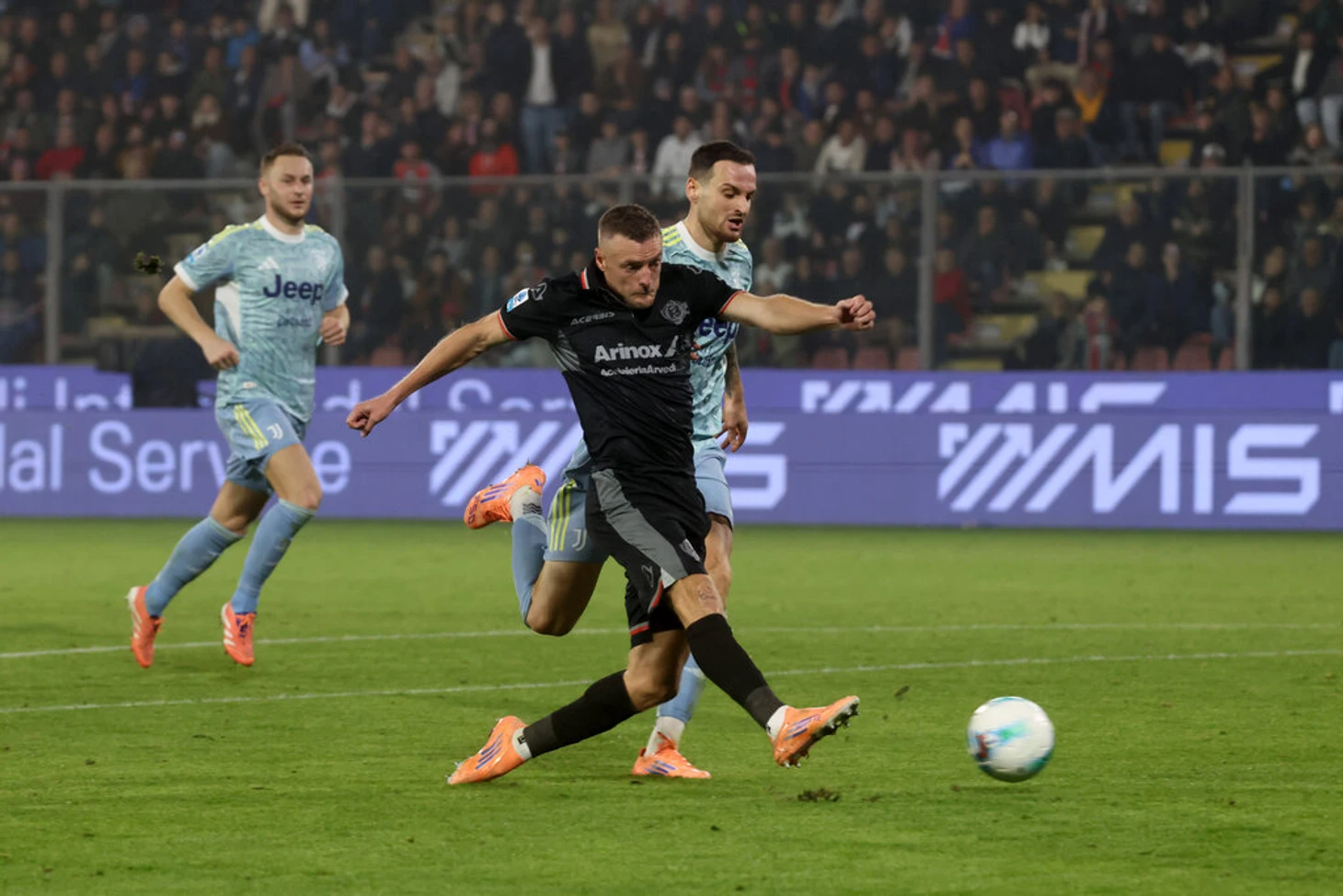
Against “Juve,” a scene unfolded as if written for a timing textbook. A high “candle,” a potentially simple clearance, and alongside him—Federico Gatti: 195 centimeters, about 90 kilograms, a defender who doesn’t hesitate to use his frame. It seemed like Vardy had nothing to catch there. But he didn’t go into an aerial battle—he attacked the moment.
When Gatti, backpedaling, reached the point where he met the ball, his feet were set narrowly, his center of gravity rose, and his balance became fragile. Vardy nudged him precisely when a shove turns not into “power,” but into a loss of balance. The defender went down, lost seconds getting up and building speed—and that reserve was enough for Vardy to convert the one-on-one.
“Bologna”: Disappear to Find the Pocket
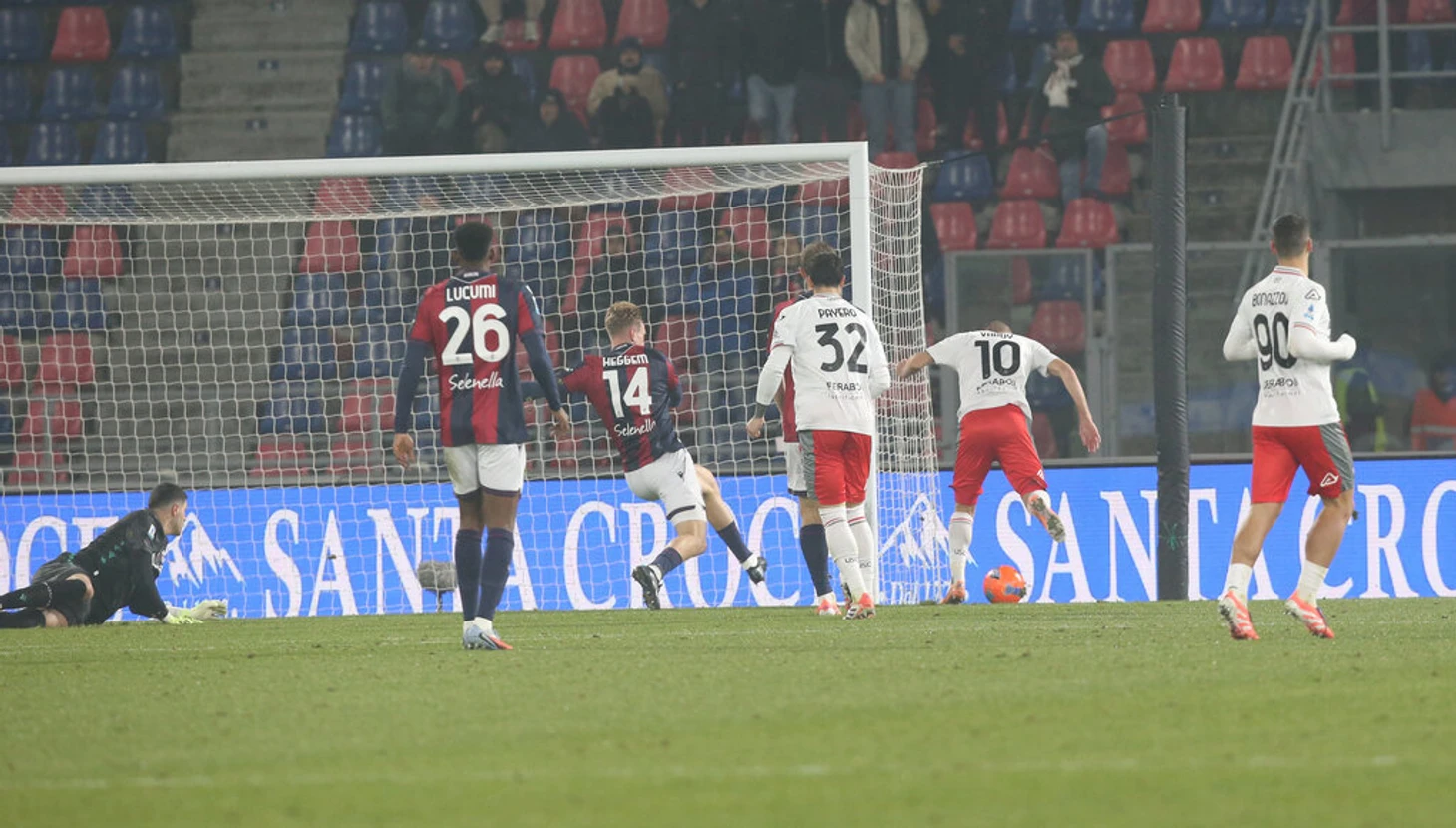
The two goals against “Bologna” were a continuation of the same philosophy. The first episode started almost as a copy: a ball clipped forward, the defender watching the high flight and preparing to clear it with a header, and Vardy already running toward him, but… not for the aerial. When the opponent won in the air, Jamie slipped behind him and there, in the blind spot, cleverly got lost and moved into the pocket to the right. The defender seemed surprised when, after the pass, he turned and no longer saw Vardy next to him. Then came the easy one-on-one.
The second goal after the break was even subtler. While the ball was still on “Cremonese”’s half, Vardy shifted into the channel between the center-back and the right-back. Bologna’s right-back was, at that moment, the only one of the back four pushed up. Meaning Jamie found the one place where, for the center-back, he would be in the blind spot (the ball went to the opposite flank—so the CB is looking there), and the wide defender who should keep him in view wasn’t there at all.
Heggem, Bologna’s defender, remembered Vardy and, before the switch reached the flank, turned again to check him. Jamie seemed at a safe distance. But he saw the chance and was already accelerating, while the Norwegian wasn’t. In the six-yard box, Vardy arrived first.
Energy Drinks, Inzaghi, and a Sense of the Future
From the outside, it may seem there is “nothing special” in his goals. But that is exactly what is special: staying invisible right up to the strike. It’s no coincidence that Eusebio Di Francesco compared Vardy to Pippo Inzaghi: he has the same talent for attacking in behind, working on the edge, and holding the line with the defenders.
Teammate Romano Floriani added everyday details—about a fridge at the club packed with energy drinks, and how his age seems to disappear in training. And Vardy speaks as if a passport is just a piece of paper: Serie A, he says, is more technical and more tactical than the Premier League, with more control of the ball—and that forces him to grow.
When the Passport Stays Silent and the Goals Speak
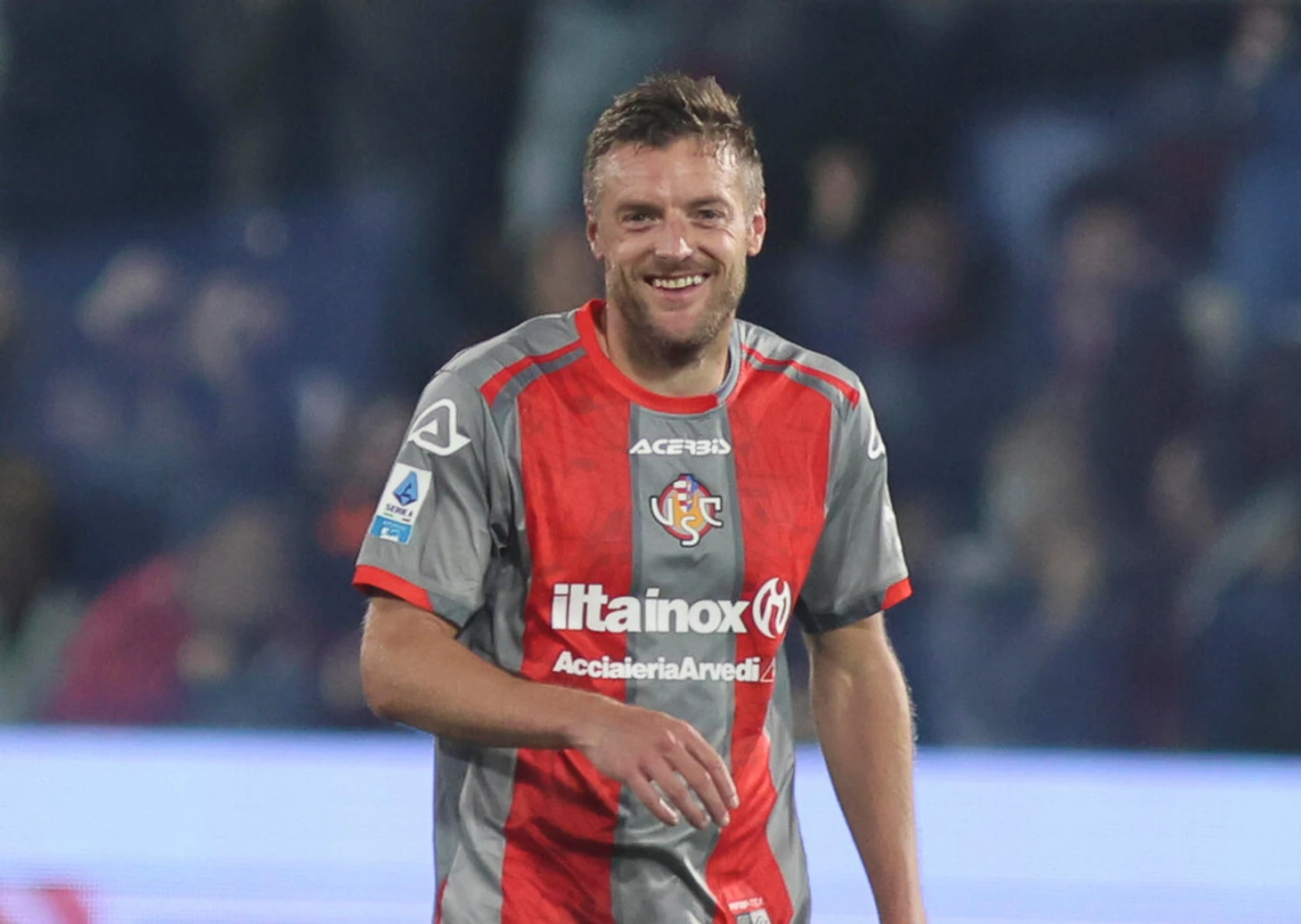
Vardy isn’t trying to beat time head-on with brute force. He beats moments: with a micro-move, a step into a blind spot, a pause instead of a sprint, the right position instead of a wrestle. At 38, he scores not because he brings youth back, but because he has automated the striker’s main craft: be where the ball will end up, and make it as simple as possible. And while it works, his story still has a continuation—as if there really is more “future” ahead.